
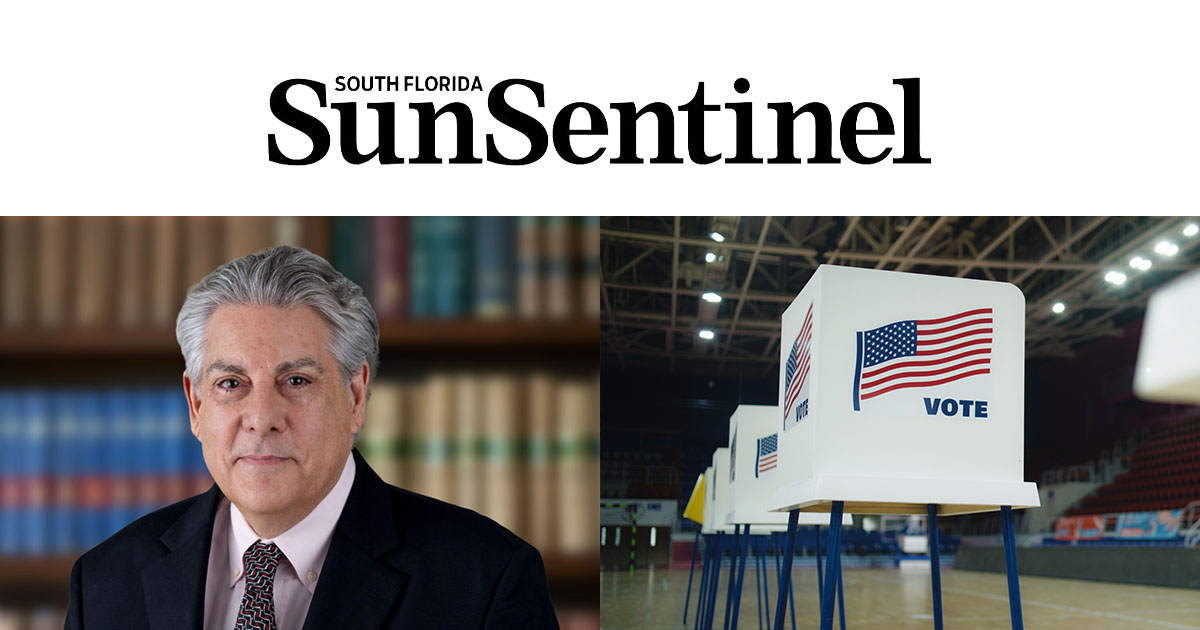
By Jeffrey Freedman
As seen in The South Florida Sun Sentinel on October 06, 2026
Tightening up voting requirements for American citizens by asking them to provide proof of citizenship at the polls, restricting mail-in voting and having officials from I.C.E. posted at the polls on election day is disruptive for every voter. For people who are disabled, however, these restrictions could make voting impossible.
According to the Center for American Progress, people living with disabilities were more than three times as likely as voters without disabilities to report difficulty casting a ballot in the 2022 election. And it is not only the disabled who are challenged to get to the polls. Their caregivers are also affected —10.3 million individuals living with a disabled person did not vote in the 2022 election.
As an attorney who has provided representation to more than 22,000 disabled Americans seeking Social Security Disability (SSD) and Supplemental Security Income (SSI) benefits, I have gained first-hand experience with the limitations faced by the disabled, many of whom have depended on voting by mail for decades.
Often, those living with disabilities have limited physical mobility, cannot drive, and/or live in institutions or group homes. While our clients are going through the process of applying for SSD, they typically live on little to no income, relying on their life savings and the generosity of family and friends to live. They may go through periods with no fixed address. Important documents such as birth certificates can easily become lost, and replacing them is a challenge — even for the able-bodied. The government’s alternative form of identification, a passport, is not typically a need in the lives of disabled individuals and is more complex and expensive to obtain than other forms of ID.
Many people who are disabled do not have easy access to the Internet. They can’t just run down to the library to use a computer, and often need assistance in finding what they need online, as well as help filling out forms. According to Douglas Kruse, PhD, co-director of the Program for Disability Research at Rutgers University, the most significant voting challenges are reported by individuals with vision and cognitive impairments. Kruse says 53 percent of voters with vision impairments experience difficulties voting.
For typical voters, using an absentee ballot or voting by mail is a convenience. For people with disabilities, it is what makes voting realistically possible. Disabled voters need to be able to use absentee voting; remote ballot-marking systems; the assistance of friends or family members to fill out ballots; and to vote using electronic ballot return or delivery (in states where this is available). Since 2002, when the Help America Vote Act passed, the Election Commission has been working for improved polling-place accessibility, more accessible voting systems, mail voting and accessible ballot delivery to make it easier for these individuals to cast their ballots.
Federal law currently protects disabled voters’ ability to vote privately and independently — which means they must have access to voting equipment and be permitted to have assistance if they want to vote at the polls. Now is not the time to reverse the progress that has been made for disabled voters. Those on SSD and Supplemental Security Income, Veteran’s Disability, those applying for benefits, and even elderly Americans who are housebound cannot be shut out of the voting process. Nor should they have to be concerned their mail-in vote might be discarded in the event a bar code is unreadable.
There are several organizations that support disabled voters: the American Association of People with Disabilities (AAPD), the National Disability Rights Network, The Arc, Autistic Self Advocacy Network, and Self Advocates Becoming Empowered.
All voters are being encouraged to confirm they are registered to vote in their specified district prior to the mid-term elections. Those who are disabled may need assistance confirming their registration. We as individuals can work with the organizations above or — we can just be there to assist and transport disabled or elderly people in our neighborhoods to the polls if that is appropriate. If you have questions, the Election Protection Hotline, (866-OUR-VOTE), USA.gov Voter Accessibility Laws or your local election office can help.
We cannot ask disabled Americans to jump through hoops to obtain acceptable identification, or to stand in long lines at the polls. Their rights and access to vote must be protected.
Jeffrey Freedman has represented clients with disabilities for more than four decades.
He is the founder of Jeffrey Freedman Attorneys, PLLC, with offices in Boynton Beach, Florida.The firm represents Social Security Disability and SSI claimants nationwide.